





Mandolin aims to improve the 3D manipulation of deformable objects using multiple collaborative robots, by optimizing grasping point location and leveraging interactive inverse finite element simulation in planning and control.
Key facts
📅 Duration: 42 months
April 2026 ➡️ September 2029
🎓 3 PhD students
🎓 1 postdoc fellow
🏦 Total funding 700 k€
Fully funded by the ANR
🤖 2 industrial use cases
Multi-robot soft manipulation
💻 Open software
Based on Assist and ROS2
📈↗️ Topical contributions
Riding the wave of soft robotics
Structure
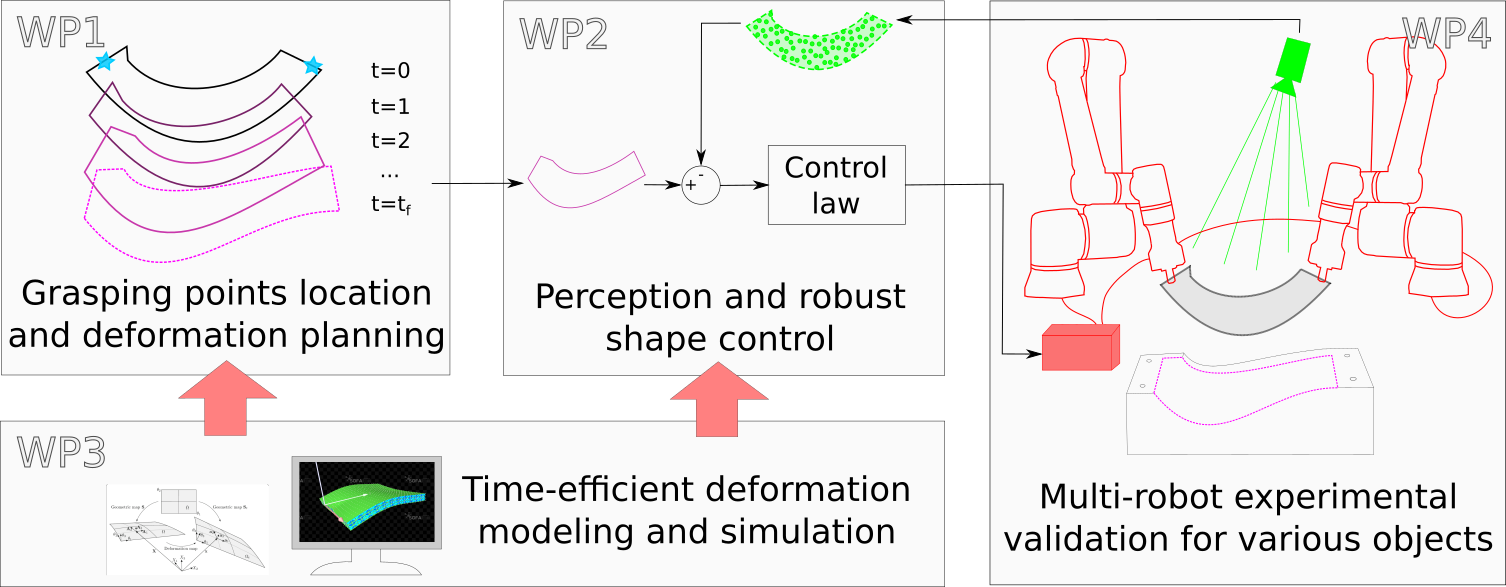
WP1 – Grasping points location optimization and deformation planning (coord. by Institut Pascal)
This WP tackles the planning of deformable object manipulation tasks. We consider multi-robot manipulation aiming at reaching the desired shape of the object. Task formulation and specification is a key issue. However, the feasibility of the desired shape remains an open problem due to the high dimensionality and nonlinearity of the interactions. In addition, interactions with the environment through contact constraints, and the way in which these contacts are made or broken, are part of the task specification. This creates variability in the object’s behavior model, and thus the need for dynamic task planning.
WP2 – Closed-loop, multi-objective deformation control (coordinated by LCFC)
This WP tackles the problem of controlling the deformation of the object in a closed loop, by using exteroceptive data to sense the object’s state. We wish to progressively integrate the deformation cues and paths, as well as the iterations of the inverse simulation, in an objective-based controller. This results in a contact and fragility-aware control law for high-precision assembly.
WP3 – Time-efficient deformation modeling and simulation (coordinated by ICube)
The main objective of this work package is to overcome the numerical obstacles related to real-time shape manipulation through Finite Element Method (FEM) simulation. This includes handling degrees of freedom (DOFs) for multi-robot systems, optimizing computations, adjusting planning based on visual feedback, and utilizing advanced mechanical models for structure simulation. To achieve this goal, we will rely on the inverse Finite Element simulation method proposed by the partners.
WP4 – Multi-robot experimental validation on manufacturing processes (coordinated by LCFC)
This practical workpackage tackles the contributions’ hardware and software implementation, as well as their validation on several use cases (UC).
UC1 – Multi-robot composite layering operation.
We consider here a two-robot setup, whose goal is to conform the shape of a prepreg sheet to that of a free-form mold. The prepreg sheet may be considered stiff and slender. The main problems consist in finding grasping point to reach a given shape, the synchronous control of the robot motions, the presence of contacts with the mold, and the stiff structure which hampers solver convergence. This use case will be developed in LCFC.
UC2 – Multi-layer rubber assembly.
We wish to develop a demo akin to outer layer assembly of raw tires. The task consists in wrapping the layer around a drum, establishing contact smoothly over the whole diameter. In contrast with UC1, the rubber is soft, thick, and subject to plastic deformation if handled improperly. The deformation planning is of paramount importance, as well as the estimation and control of the deformation state. This use case will be developed in Institut Pascal.
UC1a, 1b, 2a, 2b – Alternate UCs with n≥3 robots or human-robot collaboration.
We introduce alternate use cases: (a) using n≥3 robots in simulation, to evaluate the applicability of the methods with higher actuation dimensions, and (b) using human-robot collaborative manipulation of the deformable object, which reduces the actuation degree but introduces challenges related to task sharing.